

Maximize your score with these resources:
- Albert.io AP® Biology question banks
- Free AP® Biology cheat sheets
- Free AP® Biology score calculator
Cellular respiration powers every cell in your body by converting the chemical energy stored in glucose into ATP — the molecule that drives virtually all cellular work. For AP® Biology (CED Unit 3, Big Idea 2 — Energy), you need to trace energy transformations through each stage, explain how the electron transport chain generates most of the ATP, and connect aerobic respiration to fermentation when oxygen is absent. This topic is tested every year — expect MCQs about energy yields, FRQs asking you to trace electrons from glucose to water, and data-analysis questions about oxygen consumption rates.
The overall equation for aerobic cellular respiration:
C₆H₁₂O₆ + 6O₂ → 6CO₂ + 6H₂O + ATP (+ heat)
This equation is the reverse of photosynthesis — and the AP exam loves asking you to make that connection. The actual process occurs in four linked stages across two cellular locations: the cytoplasm (glycolysis) and the mitochondria (pyruvate oxidation, Krebs cycle, and oxidative phosphorylation).
What is Cellular Respiration?
Cellular respiration is the set of metabolic reactions that break down organic molecules (primarily glucose) to produce ATP. It can be aerobic (requires oxygen, produces ~30–32 ATP per glucose) or anaerobic (no oxygen, produces only 2 ATP per glucose via fermentation).
In eukaryotic cells, aerobic respiration occurs across two compartments: glycolysis in the cytoplasm, and everything else in the mitochondria. In prokaryotic cells (which lack mitochondria), the entire process occurs in the cytoplasm and across the plasma membrane.
| Stage | Location | Inputs | Outputs (per glucose) |
|---|---|---|---|
| Glycolysis | Cytoplasm | 1 glucose, 2 ATP, 2 NAD⁺ | 2 pyruvate, 4 ATP (net 2), 2 NADH |
| Pyruvate oxidation | Mitochondrial matrix | 2 pyruvate, 2 NAD⁺, 2 CoA | 2 acetyl-CoA, 2 CO₂, 2 NADH |
| Krebs cycle | Mitochondrial matrix | 2 acetyl-CoA, 6 NAD⁺, 2 FAD | 4 CO₂, 6 NADH, 2 FADH₂, 2 ATP |
| Oxidative phosphorylation | Inner mitochondrial membrane | 10 NADH, 2 FADH₂, O₂ | ~26–28 ATP, H₂O |
ATP
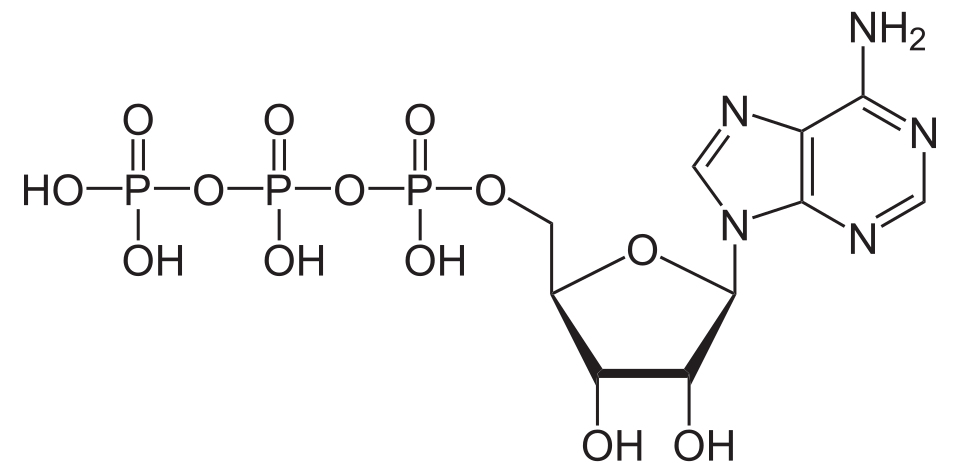

ATP (adenosine triphosphate) is the cell’s universal energy currency. Its structure — an adenine base, a ribose sugar, and three phosphate groups — stores energy in the bonds between the phosphate groups. The terminal phosphate bond is particularly unstable because the three negatively charged phosphate groups repel each other. When the enzyme ATPase hydrolyzes this bond, the terminal phosphate is released, producing ADP + Pᵢ and releasing energy that the cell couples to endergonic (energy-requiring) reactions.
The entire purpose of cellular respiration is to regenerate ATP from ADP + Pᵢ by capturing energy from the stepwise oxidation of glucose.
Stage 1: Glycolysis
Glycolysis (“sugar splitting”) occurs in the cytoplasm and is the only stage that occurs in all living cells — both aerobic and anaerobic organisms. It does not require oxygen.
The process in brief:
- Energy investment phase — 2 ATP are consumed to phosphorylate glucose, converting it to fructose-1,6-bisphosphate, which is then split into two 3-carbon molecules of G3P (glyceraldehyde-3-phosphate)
- Energy payoff phase — Each G3P is oxidized and rearranged into pyruvate, producing 2 ATP and 1 NADH per G3P molecule
Net yield per glucose: 2 pyruvate + 2 ATP (4 produced minus 2 invested) + 2 NADH
Key terms for the AP exam: glucose → fructose-1,6-bisphosphate → G3P → pyruvate. You don’t need to memorize every intermediate, but knowing that glycolysis converts a 6-carbon molecule into two 3-carbon pyruvate molecules is essential.
Stage 2: Pyruvate Oxidation
Before entering the Krebs cycle, pyruvate must be converted to acetyl-CoA. This occurs in the mitochondrial matrix:
- Pyruvate is oxidized (loses electrons and a hydrogen to NAD⁺, forming NADH)
- One carbon is removed as CO₂ (this is one source of the CO₂ you exhale)
- The remaining 2-carbon fragment bonds to coenzyme A, forming acetyl-CoA
Per glucose (2 pyruvates): 2 acetyl-CoA + 2 CO₂ + 2 NADH
Stage 3: Krebs Cycle (Citric Acid Cycle)
The Krebs cycle takes place in the mitochondrial matrix. Acetyl-CoA (2 carbons) combines with oxaloacetate (4 carbons) to form citric acid (6 carbons) — which is why this is also called the citric acid cycle. Through a series of oxidation reactions, the cycle strips electrons and hydrogen ions from the carbon compounds, loading them onto electron carriers:
Per turn of the cycle (1 acetyl-CoA): 3 NADH + 1 FADH₂ + 1 ATP (via GTP) + 2 CO₂
Per glucose (2 turns): 6 NADH + 2 FADH₂ + 2 ATP + 4 CO₂
Most of the energy extracted by the Krebs cycle is stored in the electron carriers NADH and FADH₂ — not in ATP directly. These carriers deliver their high-energy electrons to the electron transport chain, where the majority of ATP is produced.
Stage 4: Oxidative Phosphorylation (Electron Transport Chain + Chemiosmosis)
This is where the bulk of ATP production occurs — approximately 26–28 ATP per glucose. The process takes place on the inner mitochondrial membrane (the cristae), which is folded extensively to maximize surface area.
Electron transport chain (ETC):
- NADH and FADH₂ donate their electrons to a series of protein complexes (I, II, III, IV) embedded in the inner membrane
- As electrons are passed from carrier to carrier, energy is released and used to pump H⁺ ions from the mitochondrial matrix into the intermembrane space, building a proton gradient (also called the electrochemical gradient)
- At the end of the chain, electrons are accepted by O₂ — the final electron acceptor — which combines with H⁺ to form H₂O. This is why you need oxygen to breathe: without it, the ETC stalls and ATP production via oxidative phosphorylation stops.
Chemiosmosis:
- The proton gradient (high H⁺ in intermembrane space, low H⁺ in matrix) represents stored potential energy
- H⁺ ions flow back into the matrix through ATP synthase, a channel protein that uses the flow of protons to catalyze the reaction: ADP + Pᵢ → ATP
- This mechanism — using a proton gradient to drive ATP synthesis — is called chemiosmosis and is the same fundamental principle used in chloroplasts during photosynthesis
Total ATP yield from one glucose (aerobic respiration): approximately 30–32 ATP. The exact number varies because the NADH produced during glycolysis (in the cytoplasm) must be shuttled into the mitochondria, and the shuttle mechanism used determines whether each cytoplasmic NADH yields 1.5 or 2.5 ATP.
Fermentation
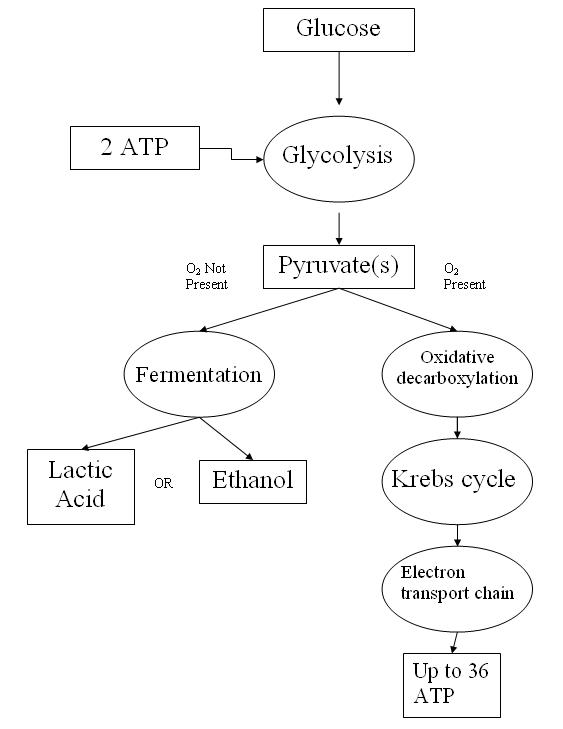
When oxygen is unavailable, cells cannot run the electron transport chain — because there is no final electron acceptor for the electrons. Without the ETC, NADH cannot be oxidized back to NAD⁺, and without NAD⁺, glycolysis stalls. Fermentation solves this problem by recycling NADH back to NAD⁺ without the ETC, allowing glycolysis to continue producing a small amount of ATP (2 per glucose).
| Feature | Alcoholic Fermentation | Lactic Acid Fermentation |
|---|---|---|
| Pyruvate converted to | Ethanol + CO₂ | Lactic acid (lactate) |
| NADH recycled to | NAD⁺ | NAD⁺ |
| Organisms | Yeast, some bacteria | Animal muscle cells, some bacteria |
| Applications | Bread rising, wine/beer production | Yogurt production, muscle fatigue during intense exercise |
| ATP yield | 2 (from glycolysis only) | 2 (from glycolysis only) |
Key point for the AP exam: Fermentation does not produce additional ATP beyond the 2 from glycolysis. Its sole purpose is to regenerate NAD⁺ so that glycolysis can continue. Aerobic respiration is approximately 15–16 times more efficient than fermentation in terms of ATP per glucose.
Test-Taking Strategies
Cellular respiration is one of the highest-value topics on the AP® Biology exam. Here’s how to maximize your score:
Mnemonic devices:
- “Glycolysis Produces Krebs’ Electrons” — The four stages in order: Glycolysis → Pyruvate oxidation → Krebs cycle → Electron transport chain
- “O₂ is the Final Electron Acceptor — FEA” — If you forget why oxygen is necessary, remember FEA: without the Final Electron Acceptor, the ETC backs up and ATP production stops
- “NADH = Nickel And Dime Hydrogen carrier” — NADH carries electrons (the “dimes” of energy currency) to the ETC where they generate the “dollars” (ATP)
Cross-topic connections:
- Photosynthesis (Unit 3) — The products of photosynthesis (glucose + O₂) are the reactants of cellular respiration, and vice versa. Both use chemiosmosis and ATP synthase — but in chloroplasts, H⁺ accumulates in the thylakoid lumen, while in mitochondria, it accumulates in the intermembrane space.
- Enzymes (Unit 3) — Every step of cellular respiration is catalyzed by specific enzymes. Temperature and pH affect these enzymes, which is why extreme conditions impair cellular respiration.
- Evolution (Unit 7) — Glycolysis occurs in all living organisms and does not require oxygen or mitochondria — evidence that it evolved early, before the atmosphere contained O₂. The endosymbiotic theory explains mitochondria as ancient aerobic prokaryotes engulfed by ancestral eukaryotes.
Common question formats:
- MCQs asking you to identify inputs and outputs of each stage — use the summary table above
- FRQs asking you to trace energy from glucose through ATP to cellular work — describe: glucose bonds broken → electrons carried by NADH/FADH₂ → ETC builds proton gradient → ATP synthase produces ATP → ATP hydrolysis powers work
- Data-analysis questions showing O₂ consumption or CO₂ production rates under different conditions
Frequent student mistakes:
- Saying “the Krebs cycle produces most of the ATP” — it doesn’t. The ETC/oxidative phosphorylation produces ~26–28 of the ~30–32 total ATP. The Krebs cycle’s main role is loading electrons onto NADH and FADH₂.
- Confusing where each stage occurs — glycolysis = cytoplasm, everything else = mitochondria (matrix for Krebs, inner membrane for ETC)
- Forgetting that fermentation does NOT produce additional ATP — it only regenerates NAD⁺
- Saying “lactic acid causes muscle soreness” — this is a common misconception. Lactic acid is actually cleared within an hour after exercise. Delayed-onset muscle soreness is caused by microdamage to muscle fibers.
Test-day shortcuts:
- If a question asks “what happens without oxygen?” → glycolysis still works, but the Krebs cycle and ETC stop. Fermentation kicks in to recycle NAD⁺.
- If a question asks about cyanide or other ETC inhibitors → the ETC stops, the proton gradient collapses, ATP synthase can’t function, and NADH can’t be recycled. The cell is forced into fermentation.
- For efficiency comparisons: aerobic = ~30–32 ATP/glucose; anaerobic = 2 ATP/glucose. That’s why aerobic organisms can sustain higher metabolic rates.
Time management: Cellular respiration FRQs often have 4 parts asking about different stages. Allocate your time evenly — don’t spend 5 minutes on glycolysis and rush through the ETC, which is where the most conceptually rich content (chemiosmosis, proton gradient) earns the most points.
Check for Understanding
Think you’ve got it? Complete the quiz below to make sure. Download your results at the end.