

Maximize your score with these resources:
- Albert.io AP® World History question banks
- Free AP® World History cheat sheets
- Free AP® World History score calculator
What is the Columbian Exchange?
The Columbian Exchange refers to the massive, sustained transfer of plants, animals, diseases, people, and ideas between the Eastern Hemisphere (Europe, Africa, Asia) and the Western Hemisphere (the Americas) following Christopher Columbus’s 1492 voyage. It is called an “exchange” because movement went in both directions — but as you’ll see, the exchange was profoundly unequal in its effects.
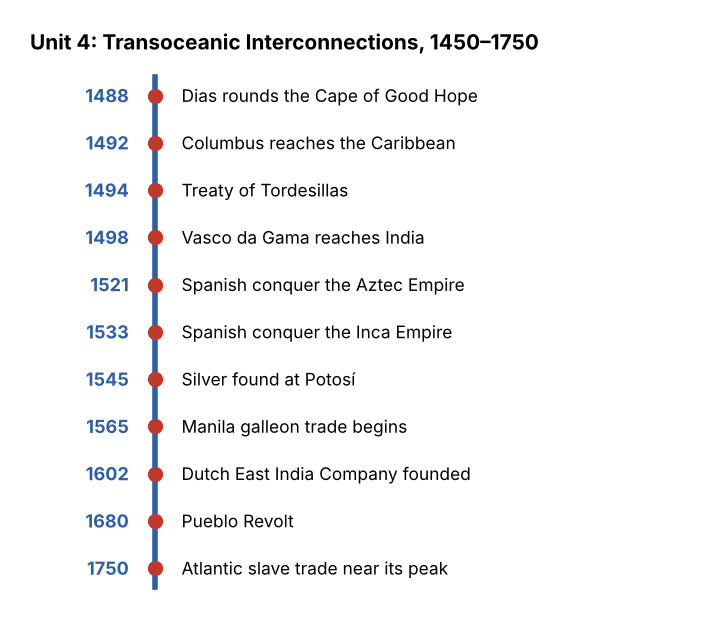
For AP® World History, the Columbian Exchange is a foundational event that connects Period 4 (1450–1750). It touches every major APWH theme: trade networks, demography, environment, cultural diffusion, and political power. Understanding its causes, consequences, and inequalities is essential for both MCQ and FRQ success.
Columbian Exchanges
The biological exchange across the Atlantic transformed diets, economies, and ecosystems on both sides of the ocean. Key transfers to know:
From the Americas to Europe/Africa/Asia:
- Crops: Maize (corn), potatoes, tomatoes, sweet potatoes, cacao, tobacco, squash, pumpkins, vanilla, chili peppers, avocados, peanuts, rubber
- Animals: Turkeys, llamas, alpacas, guinea pigs
From Europe/Africa/Asia to the Americas:
- Crops: Wheat, rice, sugarcane, bananas, olives, onions, apples, citrus fruits
- Animals: Horses, cattle, pigs, sheep, goats, chickens
- Diseases: Smallpox, measles, typhus, influenza, malaria (also carried by enslaved Africans)
The demographic impact of introduced animals was profound: horses transformed warfare and mobility for Plains Indian peoples; cattle and pigs provided new food sources but also competed with native wildlife; and the reintroduction of the horse to the Americas fundamentally reshaped indigenous cultures on the Great Plains.


The Good, the Bad, and the Ugly of the Columbian Exchange
The Columbian Exchange is not a story of mutual benefit — it was deeply asymmetrical. Europeans gained high-calorie, easily grown crops that fueled population growth; indigenous Americans gained diseases that killed them by the tens of millions.
Demographic impact on the Americas (catastrophic):
Native American populations had no prior exposure to Old World diseases and therefore no immune resistance. Smallpox, measles, typhus, and influenza swept through indigenous communities in devastating waves, beginning even before direct European contact in many regions. Historians estimate that 50–90% of the pre-Columbian indigenous population died within a century of contact — one of the largest demographic catastrophes in human history. This population collapse:
- Facilitated European conquest by eliminating large portions of the populations that would otherwise have defended their territories
- Created labor shortages on plantations, which drove the transatlantic slave trade as Europeans sought enslaved Africans as a replacement workforce
- Left vast tracts of previously cultivated land appearing “empty” to Europeans, reinforcing colonial land seizures
Demographic impact on Europe (positive):
American crops — especially potatoes and maize — were high-yield, calorie-dense, and adaptable to European climates. They fed rapidly growing European populations, contributing to a demographic expansion that fueled colonization, urbanization, and industrialization. The potato, in particular, became a dietary staple across northern Europe and Ireland (with the Irish potato famine of the 1840s demonstrating the danger of monoculture dependence).
The Whys and Hows of the Columbian Exchange
The Columbian Exchange was not an accidental or neutral process — it was driven by European colonialism, commercial capitalism, and forced labor systems.
Why Europeans sought new lands: European states in the 15th–16th centuries competed intensely for trade routes, precious metals, and agricultural land. The Ottoman Empire’s dominance of overland routes to Asia incentivized Atlantic exploration. Columbus’s 1492 voyage was backed by the Spanish Crown explicitly to find a western route to Asian markets.
How colonization structured the exchange:
- Plantation agriculture: Europeans established cash crop plantations (sugar, tobacco, cotton, indigo) in the Americas, which required massive labor. This drove the transatlantic slave trade, forcibly transferring approximately 12.5 million Africans to the Americas over four centuries. The plantation system transformed American landscapes, replacing diverse ecosystems with monocultures
- Silver extraction: Mines in Peru (Potosi) and Mexico (Zacatecas) produced vast quantities of silver, which flowed through global trade networks to China (which required silver for taxes) and fueled a global price revolution. This silver web connected the Americas, Europe, Africa, and Asia in an integrated global economy for the first time
- Invasive species: European animals (especially pigs, cattle, and rats) spread rapidly through the Americas, often ahead of European settlers, transforming ecosystems and competing with or eliminating native species
Test-Taking Strategies
The Columbian Exchange is almost guaranteed to appear on the AP® World History exam — it has appeared on every released exam in some form. It is particularly common as a DBQ or LEQ topic, and as context for MCQ stimulus questions.
Key analytical frameworks:
- Demographic: Population collapse in the Americas vs. population growth in Europe. Always explain the mechanism (disease + lack of immunity) not just the outcome
- Environmental: Introduction of Old World species altered New World ecosystems; plantation monocultures replaced diverse landscapes
- Economic: Silver connected global trade networks; plantation agriculture created the transatlantic slave trade; new crops transformed food systems across hemispheres
- Social/Cultural: Forced migration of Africans created new creolized cultures in the Americas; horse adoption transformed Plains Indian cultures; Catholic missionaries spread Christianity
Cross-topic connections the AP exam tests frequently:
- Columbian Exchange → Atlantic slave trade: Disease killed the indigenous labor supply, which Europeans replaced with enslaved Africans. This is a direct causal chain the exam tests repeatedly
- Columbian Exchange → global silver trade: American silver funded European economies and was required for trade with China (Ming dynasty taxation demands). This created the first truly global trade network and connects to AP® World History Period 4 trade themes
- Columbian Exchange → European population growth and industrialization: High-calorie American crops (potato, maize) fed growing European populations, providing the labor surplus that later fueled industrialization
- Columbian Exchange → environmental history: The introduction of European animals, destruction of native flora, and plantation monocultures are early examples of human-driven ecological change — connect to APWH’s environmental history theme
2012 AP® World History FRQ: “Compare demographic and environmental effects of the Columbian Exchange on the Americas with ONE other region.” Model answer structure:
- Americas vs. Europe: Americas experienced demographic catastrophe (disease, 50–90% mortality, displacement); Europe gained population through new crops and wealth from colonial exploitation. Environmentally: Americas saw deforestation, monoculture, invasive species; Europe gained diverse new food crops
- Americas vs. Africa: Americas lost population; Africa lost population too (via slave trade) but also gained some American crops (cassava, maize) that stabilized nutrition in some regions. The slave trade’s demographic drain on Africa is the critical environmental/demographic parallel
Common mistakes to avoid:
- “Exchange” implies equality: It did not. The exchange was asymmetrical — indigenous Americans bore catastrophic losses while Europeans and their empires gained. Don’t write as if all parties benefited equally
- Disease was the primary demographic cause: Student essays often cite warfare as the main cause of indigenous population collapse. Correct answer: disease came first and was by far the larger killer; warfare followed in already-weakened populations
- Timing matters: The exchange began in 1492 but continued for centuries. The plantation-slave trade system developed in the 1500s–1800s. Don’t treat it as a single event
FRQ scoring tip: For any Columbian Exchange essay, earn complexity credit by explaining causation in both directions (what caused the exchange AND what the exchange caused), and by addressing both similarities and differences if a comparison is required. Show that you understand the global systemic connections, not just isolated facts about specific crops or animals.