

Maximize your score with these resources:
- Albert.io AP® Physics 1 question banks
- Free AP® Physics 1 cheat sheets
- Free AP® Physics 1 score calculator
Friction appears in nearly every major AP® Physics 1 topic — Newton’s laws, inclined planes, circular motion, energy. If you don’t know when to use static vs. kinetic friction (and when to use neither), you’ll lose points across all of these. This article gives you the complete system: which coefficient to reach for, when to switch between them, and how friction connects to work, energy, and circular motion.
| Formula | Equation | Notes |
|---|---|---|
| Maximum static friction | fs,max = µsN | Object slides when applied force exceeds this value |
| Kinetic friction | fk = µkN | Constant during sliding; µk < µs |
| Normal force on incline | N = mg cos(θ) | Perpendicular component of gravity |
| Sliding condition on incline | tan(θ) > µs | Mass cancels; depends only on angle and surface |
| Max speed in circular curve | vmax = √(µsgr) | Static friction provides centripetal force; mass cancels |
| Energy dissipated by friction | Q = fkd = µkNd | Converts mechanical energy to thermal energy |
Static Friction vs. Kinetic Friction: The Core Distinction
Static friction prevents motion before it starts. Kinetic friction resists motion that’s already happening. Getting this sequence right determines your entire solution path.
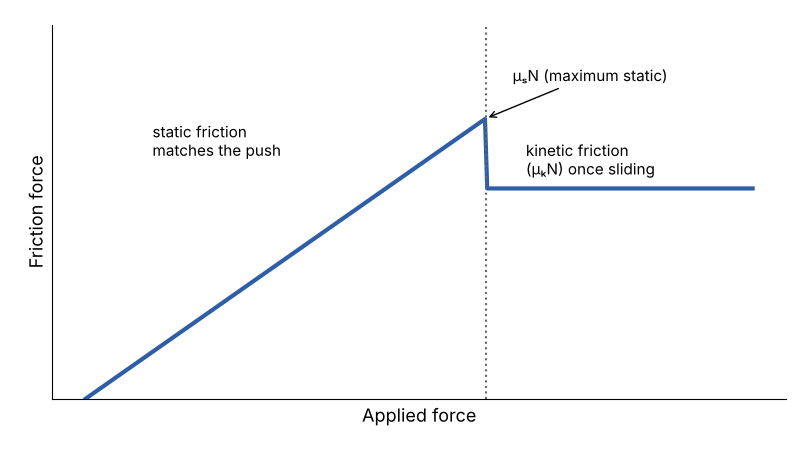
- Static friction acts when objects are at rest or moving together as a unit. Its magnitude adjusts to exactly match the applied force, up to a maximum: fs,max = µsN. Once you exceed this maximum, the object slides. Crucially, µs > µk — objects are harder to start sliding than to keep sliding.
- Kinetic friction acts on sliding objects. Unlike static friction, it doesn’t adjust — it has a fixed value: fk = µkN. This constant makes kinetic friction problems cleaner algebraically.
The critical exam sequence: first compare the applied force to µsN. If applied force < µsN, no sliding — fs = applied force. If applied force > µsN, sliding — switch to fk = µkN for all subsequent calculations.
Coefficients of Friction and Normal Force
µs and µk are dimensionless numbers characterizing how “sticky” two surfaces are. They depend only on the materials in contact — not on contact area, object weight, or speed.
| Surface Pair | µs (typical) | µk (typical) | Exam Relevance |
|---|---|---|---|
| Wood on wood | 0.5 | 0.3 | Classic AP scenario. µs nearly double µk. |
| Rubber on concrete | 0.9 | 0.7 | Car braking. Locked wheels (kinetic) stop less efficiently. |
| Ice on ice | 0.04 | 0.02 | Very small coefficients. µk is still half µs. |
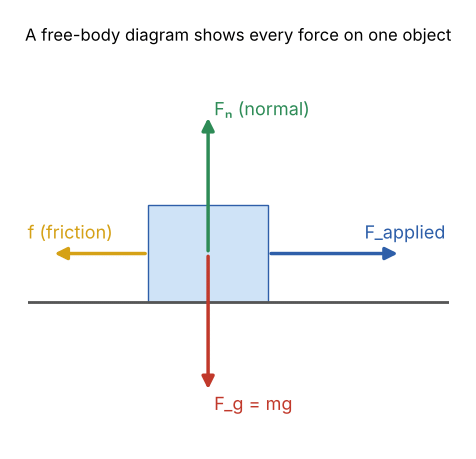
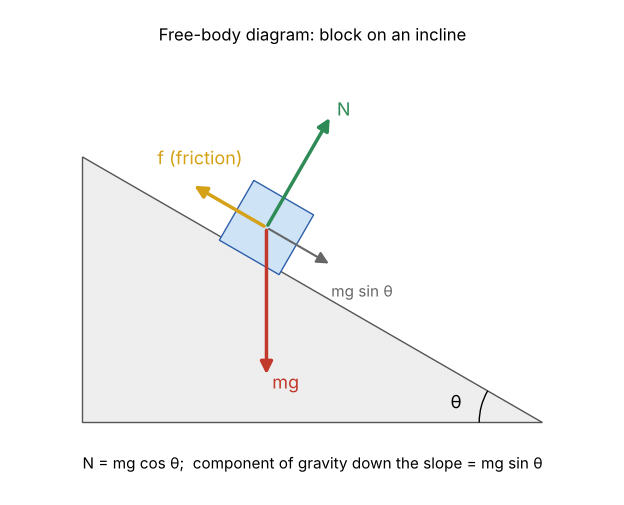
The normal force N is always perpendicular to the surface. On a horizontal surface: N = mg. On an inclined plane: N = mg·cos(θ). On an incline, N is reduced, so friction is reduced — which is why ramps make sliding easier even before considering the gravity component along the slope.
Friction Force Equations and When to Apply Them
- Static friction (object at rest or on the verge of motion): fs ≤ µsN. Static friction adjusts to prevent motion. Only at the exact moment of sliding does fs = µsN.
- Kinetic friction (object moving): fk = µkN. An equation, not an inequality. This value is constant throughout the motion.
Worked example: A 5 kg block on a horizontal surface, µs = 0.6, µk = 0.4. Apply 20 N. Max static: fs,max = 0.6 × 50 = 30 N. Since 20 N < 30 N, block doesn’t slide: fs = 20 N, a = 0. Now apply 35 N: 35 > 30, so it slides. fk = 0.4 × 50 = 20 N. Net force = 35 − 20 = 15 N. a = 15/5 = 3 m/s².
Friction on Inclined Planes and Complex Scenarios
On an incline at angle θ, N = mg·cos(θ) and the component of weight along the slope = mg·sin(θ). The object slides when mg·sin(θ) > µs·mg·cos(θ), which simplifies to tan(θ) > µs. This result is independent of mass — heavier objects don’t slide more easily on the same surface.
| Scenario | Normal Force | Friction Equation | Key Insight |
|---|---|---|---|
| Horizontal surface | N = mg | f = µN | N equals full weight |
| Inclined plane | N = mg·cos(θ) | f = µ·mg·cos(θ) | Slides if tan(θ) > µs |
| Object pushed into surface | N = mg + Fpush | f = µ(mg + Fpush) | Extra vertical force increases friction |
| Horizontal curve (car) | N = mg | fs = mv²/r | Friction provides centripetal force |
Friction and Work: Positive, Negative, and Zero
Kinetic friction always does negative work on the sliding object: Wf = −fkd. This converts mechanical energy to thermal energy. When kinetic friction is present, mechanical energy is not conserved. Use the work-energy theorem:
Wother forces − fkd = ΔKE
Static friction can do positive, negative, or zero work. A foot pushing off the ground uses static friction to accelerate the body forward — positive work. A stationary object with static friction has zero displacement, so zero work. This nuance appears in energy FRQs that ask whether friction is doing work on the object.
Test-Taking Strategies
Mnemonic: “Static sticks, kinetic kicks.” Static friction sticks the object until a threshold is exceeded. Kinetic friction acts on objects already kicked into motion. This tells you which coefficient to use instantly.
Mnemonic: “µs for Strong, µk for Keep going.” Static (s) is stronger — it takes more force to start sliding. Kinetic (k) describes what keeps happening once sliding starts. µs > µk always.
Mnemonic: “Angle beats mass.” For inclined planes, sliding depends on tan(θ) vs. µs. Mass cancels out. A heavier block does NOT slide more easily on the same surface at the same angle.
Cross-topic connections: Friction shows up in three distinct AP® Physics 1 contexts, and the exam connects them. In Newton’s Second Law problems, friction is a force in ΣF = ma — constant value fk = µkN once sliding. In energy problems, friction dissipates mechanical energy: Q = fk·d, and you use the work-energy theorem. In circular motion, static friction provides centripetal force: µsmg = mv²/r → vmax = √(µsgr). The AP exam frequently pairs two of these in the same multi-part FRQ — part (a) uses Newton’s laws, part (b) uses energy with friction dissipation.
Common question formats:
- “Does the object slide?” Compare applied force to µsN. The answer determines the rest of the solution.
- Inclined plane acceleration: N = mg·cosθ, fk = µkN, net force along slope = mg·sinθ − fk, a = g(sinθ − µkcosθ).
- Circular motion + friction: µsmg = mv²/r → vmax = √(µsgr). Mass cancels. Solve in two lines.
- Stopping distance: ½mv² = µkmgd → d = v²/(2µkg). Mass cancels again. This is faster via energy than kinematics.
Frequent student mistakes:
- Confusing µs and µk. Use µs to determine if the object slides. Then switch to µk for all subsequent calculations once sliding occurs.
- Using N = mg on inclines. Write N = mg·cosθ explicitly first. This error cascades through the entire problem.
- Treating static friction as always at maximum. Static friction equals the applied force component, up to µsN. The maximum only applies at the instant of sliding.
- Forgetting friction in Atwood/connected-system problems. If a horizontal block is connected to a hanging mass via a string, include fk = µkmg in the horizontal block’s Newton’s law equation.
Test-day shortcuts: The instant you see an incline + friction coefficient, compute tan(θ) and compare to µs — this 5-second check sets the entire solution path. For stopping distance, use energy (d = v²/[2µkg]) rather than kinematics — one step, mass cancels. For circular motion max speed, memorize vmax = √(µsgr) and write it immediately; the entire MCQ is solved in 20 seconds. Budget 2–3 minutes for inclined plane FRQ parts; the incline forces setup (N = mg·cosθ, along-slope balance) is predictable and worth every second of careful setup.